

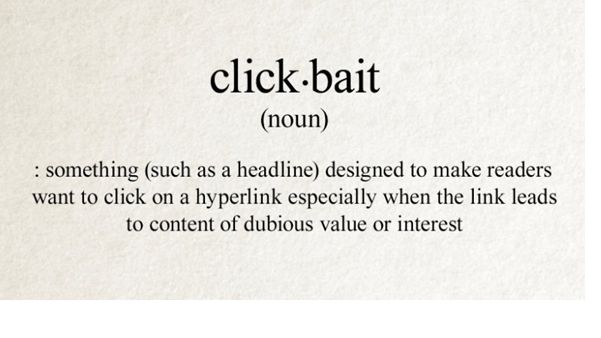
Every year in September a carefully selected group of words are added to the Oxford English Dictionary, words that have become so ingrained within our lexicon that they’ve earned the right to appear within the hallowed pages of the OED. Along with words such as scrumdiddlyumptious, Yoda-like and moobs is the inclusion of the word clickbait, but what exactly is clickbait?
What is Clickbait?
Clickbait is the act of intentionally over-promising in an attention-grabbing headline or images. We see clickbait all the time within our day to day lives, it is all over social media normally with the titles ‘you’ll NEVER believe it…’ or ‘what happened next will shock you’ all these tempting phases are an attempt to lure you in and spark your curiosity to gain a click.
For example ‘Computer Keyboard Shortcuts’ would not be viewed as clickbait whereas ‘Beyoncé’s Favourite Keyboard Shortcuts’ or ‘Using Keyboard Shortcuts Could Help You Lose Weight’ would be.
These posts get a lot of clicks and the more clicks they get the more prominently they will appear in your social media feeds. Over time, these clickbait stories can drown out the content you actually want to see.
Why Do People Create Clickbait?
The assumption is that you’d want a user to do more on your website than simply click however in the world of clickbait clicks are the prize. Most sites that use clickbait use numbers such as page views or unique visitors to measure success.
Some online content creators are guilty of using clickbait to promote their work and it works, curiosity gets the best of you and you click. Readers take the bait and the publisher is rewarded with yet another click.
Due to the vast and ever-changing nature of the internet, getting your page viewed is difficult. Content creators are faced with constantly changing algorithms that can propel them to success or simply dismiss their work, attention grabbing headlines are therefore a safe bet.
What Actually Counts as Clickbait?
How do you decide what is and isn’t clickbait? Buzzfeed’s Editor-in-Chief Ben Smith’s claim that his website “doesn’t do clickbait” raised several eyebrows in the media industry, however, he based this statement on the fact that his website delivers the content that the headline promises, regardless of how attention-grabbing they may be. There is constantly an ongoing discussion on what should and shouldn’t be classed as clickbait.
There is no universally agreed definition and that grey area is precisely what allows clickbait to thrive. Publishers can always argue that their headline was simply compelling, not deceptive. The reader, who has already clicked, often has no way to reclaim the time spent finding out.
For some the distinction lies in deception, if the headline promises some magical weight loss trick and then doesn’t deliver the promised content then this is clickbait. However, for others simply using a catchy or provocative headline is enough to be seen as clickbait.
What is Clickbait on Social Media?
Clickbait has an entire ecosystem devoted to it. Social networking sites such as Facebook, TikTok, Instagram and X (previously known as Twitter) center their apps on user activity, such as the number of likes, shares, viewing-time and frequency of clicks. This causes the social media platforms to reward clickbait content.
The Emotional Triggers
Social media as a whole is filled with clickbait because it is designed to create hyper emotional responses. Outrage, curiosity, excitement and fear are all responses generated from clickbait. Once clickbait is created, it is very likely to be re-shared.
The Ongoing Algorithm Problem
Social platforms have become increasingly aware of this and have taken steps to address it. Facebook, for example, has repeatedly updated its algorithm to reduce the reach of pages that consistently use engagement-bait, posts that explicitly ask for reactions or use deliberately misleading headlines. But these measures are imperfect and the incentive to use clickbait tactics on social media remains strong wherever attention translates to advertising revenue.
Misinformation and Clickbait
In social media, clickbait and misinformation coexist and this creates real life problems. When a sensationalised headline that is not accurate gets published, it starts a domino effect that makes it almost impossible to stop. This causes a distorted perception of reality that can have a real life impact on people.
Is Clickbait Dangerous?
Even legit content creators use clickbait in their headlines. When cybercriminals use it, it becomes a form of social engineering. Emotionally driven headlines provoke irrational behaviour that can get a user to click a link that would otherwise be avoided. This could lead to being a victim of a phishing scheme, malware and even ransomware.
How Generative AI is Making Phishing Attacks More Sophisticated
Traditionally, people relied on signs such as bad grammar, strange wording, an implausible argument, etc. to identify unsafe links. Many of these signs have now been removed thanks to generative AI. Phishing emails and posts created with AI are now structurally and grammatically flawless, contextually convincing and personalised to the target. A 2024 study found that AI-based phishing lures were clicked on more than the traditional ones.
How to Avoid Clickbait?
It may be impossible to avoid clickbait completely, as the internet structure revolves around it. Still, there are steps to be taken to reduce the amount of clickbait encountered and the risks to a greater extent.
-
- Pause Before You Click: Do you notice a headline that states a verifiable claim? Does it have the purpose to provoke anger with a title like ‘you won’t believe this’ or ‘the shocking truth’? If it feels like a tactic is in place, it probably is.
- Is the Source Reliable?: Unknown sites, misspellings, the source of the reported information does not match the title and the domain name explains a lot.
- Check the URL: Some phishing links also use URL shorteners, keeping the destination a secret.
- Be Especially Cautious in Your Inbox: Be particularly sceptical of emails containing urgent language, unexpected attachments, or links that ask you to verify account details, confirm a payment, or access a document you weren’t expecting
A Note on Clickbait in the Workplace
For businesses, the risks associated with malicious clickbait extend beyond the individual. A single employee clicking a phishing link can give an attacker access to internal systems, customer data and financial accounts. Phishing is the leading cause of data breaches, and social engineering tactics, including clickbait-style lures, are the method of choice for the majority of cybercriminal operations.
Staff training, clear reporting procedures for suspicious emails, and robust endpoint security are the foundations of any effective defence. If you’re unsure whether your business has adequate protections in place, a conversation with your IT provider is a sensible starting point.
Lucidica provides IT support for London businesses. If you have concerns about cybersecurity, phishing, or protecting your team from online threats, get in touch with our team.
Lucidica provides London based IT support for businesses